Interactive tutorial
A golf practice game online that teaches club choice, power and wind
Not sure which golf club to use from 140 yards with water in front? Pick the club, set the power, read the wind, then find out what your ball did and why. It is the part of golf that decides an amateur round, and the part no highlight reel ever slows down enough to explain.
Pick the club and find out what happened
One situation at a time: choose the club, the power and the aim, read the wind, and watch where the ball finishes and why.
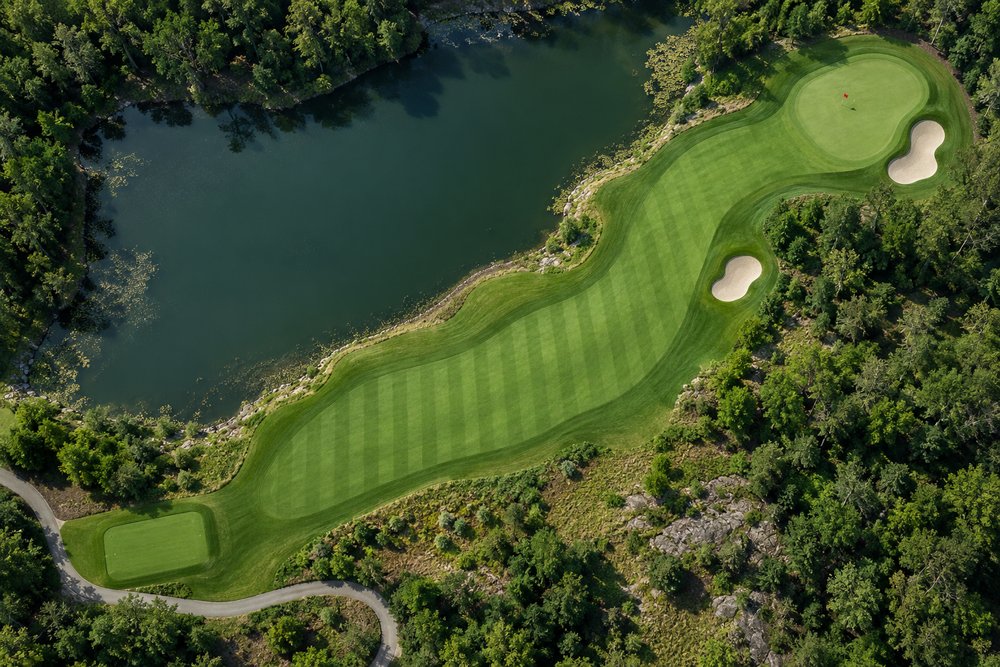
140 yd
Par 3
- Your carry
- -
- Needed
- -
- Finish
- -
- Short
Carry did not reach. Take one club more, or more power into the wind.
- Pin high
The right number. Any miss left or right is aim or crosswind, not the club.
- Long
Through the green. Usually worse than short, so club down when in doubt.
Short par 3 along the water
Choose your club
Set your power
7 iron at this power carries about 150 yd
Aim
Water hugs the whole left side and two bunkers sit right.
Second game
Mini golf: six holes to putt out
The practice tool above is about choosing a club. This one is about touch. Drag back from the ball to set the line and the strength, let go, and watch it run. Walls give the ball back, water costs a stroke and returns you to where you played from, and sand kills the pace.
Each hole has a par. Beat it for three stars, match it for two. Collect the gems on the way for a course total, but a gem that costs you an extra putt is rarely worth it, which is the same trade a real golfer makes between the safe line and the greedy one.
- Short drag, soft putt. Long drag, full power.
- Bank shots off the walls are often the quickest way round a corner.
- A ball rolling too fast will lip out, so arrive at the hole slowly.
Why club choice is the whole game for most players
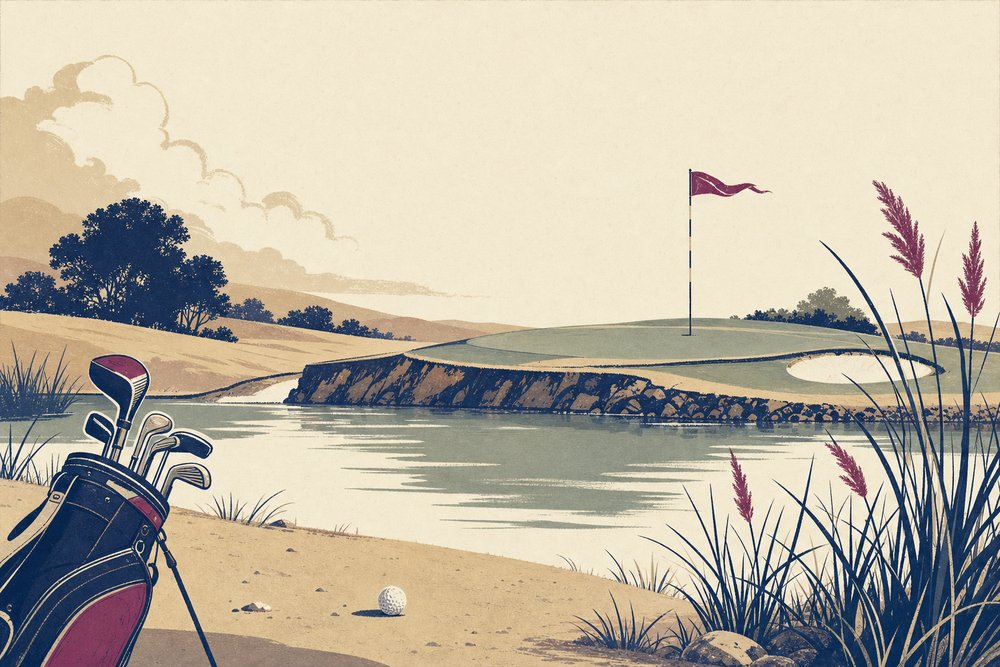
Watch an amateur four-ball for an afternoon and you will see the same shot again and again. The swing is fine. The contact is fine. The ball finishes thirty feet short of the flag, in the front bunker, or in the water that the player looked at for a full minute before pulling a club that could not clear it on its best day. The stroke was never the problem. The decision was.
Professionals are separated from good amateurs by many things, but the one a beginner can copy immediately is this: they know their carry number for every club, and they choose the club that carries the trouble comfortably rather than the club that might just reach the flag. That kind of club choice is something anybody can start making on their first round, and it costs nothing. It is also the one skill a golf practice game can train properly, because it lives in your head, not in your hands.
Carry, not distance: reading a golf club distance chart
Ask a golfer how far they hit a 7 iron and you will usually get their best ever number, measured where the ball came to rest on a firm fairway in summer. That figure is useless over water and misleading over a bunker, because what matters is where the ball lands, not where it stops.
The tool above works in carry for exactly this reason, and the golf club distance chart below uses the same figures. When it says a 7 iron carries 150 yards at full power, that is the landing point. Anything between the tee and that number is trouble you have not cleared.
| Club | Carry (yards) | Usual job |
|---|---|---|
| 6 iron | 162 | Long approach, par 3 over 160 |
| 7 iron | 150 | The reference club most players know |
| 8 iron | 138 | Mid approach |
| 9 iron | 125 | Short approach with height |
| Pitching wedge | 110 | Full wedge into a receptive green |
| Lob wedge | 80 | Short carry over a bunker |
Treat any golf club distance chart, this one included, as a starting point. Ten balls with each club on a range, counting where they land, will give you your own column, and that is the only one worth deciding with. Once you have it, the question of which golf club to use stops being a guess and becomes arithmetic plus the wind.
What the wind actually does
Wind is the variable amateurs underestimate most consistently, and it is asymmetric. A headwind makes the ball climb, and a climbing ball loses distance faster than the wind speed alone suggests. A tailwind flattens the flight and adds less than the headwind took away, while also removing the spin that would have stopped the ball on the green.
The practical rule is unglamorous: into the wind, take more club and swing easier, because a harder swing adds spin and spin is what the wind punishes. Downwind, expect the ball to run.
What a golf practice game online can and cannot teach
A screen cannot fix your swing, and this golf practice game does not pretend to. It leaves out spin, lie, slope and elevation on purpose. What it can do, like a tutorial that shows the answer at once, is let you practise golf shots online as decisions, dozens of them in ten minutes, with the consequence shown straight away. On a real course you make perhaps fifteen club choices worth thinking about in a round, and you rarely find out which of them cost you.
That is also why nothing is scored. A leaderboard would reward luck with the power bar. The feedback after each shot rewards the reasoning behind the club choice, which is the part that carries over to the first tee. Used that way, a golf practice game is closer to a rules quiz than to an arcade.
A short tutorial: three situations worth rehearsing
The forced carry
Water in front of a green concentrates the mind and ruins the decision. The only question is which club carries the far edge of the hazard with room to spare, and the answer is almost never the club that reaches the flag exactly.
The long approach into the breeze
This is where most rounds leak strokes quietly. The yardage says one club, the wind says two more, and pride says one less. Taking enough club here is the single cheapest improvement available to a mid-handicap player.
The downwind wedge
The shot that flies the green. Downwind a wedge loses the spin that would have held the surface, so the ball lands and keeps going. The fix is to land it shorter deliberately rather than to swing softer and hope.
How this connects to reading a tournament
Once these decisions feel familiar, a leaderboard stops being a list of names and becomes a set of conditions. A firm links course in a crosswind rewards a low ball flight and patience; a soft, long parkland course rewards carry distance. That is why the same players contend at the same events year after year, and it is the most useful thing a bettor can understand before looking at a single price.
If you want the betting side next, the guide to betting on golf explains the markets in the order they make sense to learn, golf odds explained shows what a price is actually claiming, and the comparison of Canadian golf betting sites lists where those markets are offered. If you would rather keep working on the game itself, come back and practise golf shots online here before your next round, then check the beginner club guide for which golf club to use from sand and rough.
Common questions
Questions about practising golf decisions
01Which golf club should I use from 140 yards?
For most amateur men a 7 or 8 iron, and for most amateur women a hybrid or a long iron. The honest answer is that it depends on your own carry distance, which is why the tool asks you to choose and then tells you what happened.
The number that matters is carry, not total distance. A club that rolls out to 140 on a dry fairway is short of a green with a bunker in front of it.
02How much distance does wind take away?
A ten kilometre an hour headwind costs roughly five per cent of carry, and it rises steeply from there because the ball climbs into it. Downwind gives back less than the headwind takes, which surprises people.
Crosswind costs less distance but moves the ball sideways, and on a green guarded left and right that is the more expensive error.
03Is the practice tool a real golf simulator?
No. It models carry distance, power and wind, which is enough to teach club selection, and it deliberately ignores spin, lie, elevation and the shape of your own swing.
It is a teaching tool for the decision, not a launch monitor. The numbers are typical amateur carries, not your numbers.
04Why is being long worse than being short?
Greens are usually built to receive a shot from the front, so the ground short of the green is cut and the ground behind it often is not. A chip back down a green running away from you is the hardest short shot in golf.
Short of the green you are usually putting from the apron. Through the back you are frequently playing out of thick grass towards a flag you cannot stop the ball near.
05How many practice holes are there?
Three in the decision tool, each built around a choice rather than a view: a par 3 along the water with a crosswind, a long approach into the breeze, and a downwind wedge that will not hold.
You can replay any of them. Nothing is scored and nothing is saved, because the point is the reasoning, not a leaderboard.