Advertising disclosure. This independent comparison website helps consumers choose the best available product that meets their needs. We offer a high quality advertising service by only featuring established brands from registered operators in our reviews. Please note that while we try to provide you with up-to-date information, we do not compare all operators on the market.
Affiliate disclosure. The main focus of golfbetting.ca is to provide you with objective online casino reviews and guides. To sponsor our model, we include affiliate links in our content. If you register through such a link, we will receive a small commission at the cost of the casino; this does not affect the terms of your own deal. We do not compromise on the quality of our service and list only registered operators that have been checked and tested based on our methodology.
Golf odds explained: reading a price, each way terms and the implied chance behind it
A price is a claim about how likely something is, and that is all you need to know about how golf odds work. With golf odds explained as percentages, the claim turns back into a number you can argue with, and this page shows what the whole field costs you.
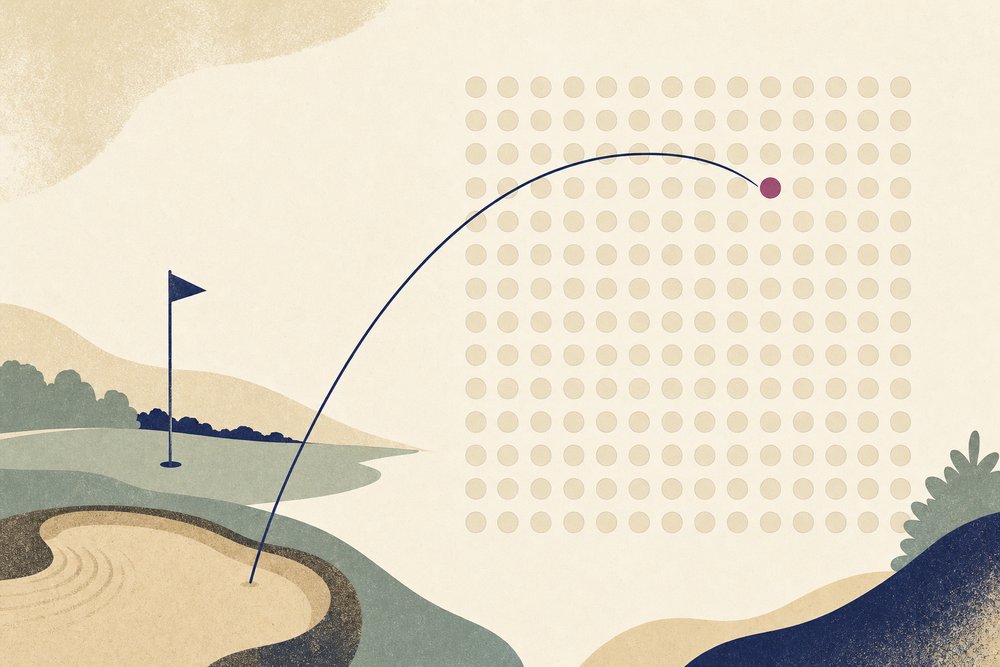
A price is a claim about how likely one landing spot is among many.
01
One price, in plain numbers
Type the decimal price a sportsbook shows for a player. The calculator turns it into the chance that price implies, and works out what an each-way bet would return.
Implied chance--
Win-only return
-
Each-way stake
-
Return if he wins
-
Return if he places
-
02
What the whole field costs you
Paste the prices of every player you are considering, separated by commas. Add the implied chances up and the total tells you how much the book has built in above one hundred per cent. That surplus is the margin, and in golf it is larger than in almost any other sport because the field is enormous.
fair 100%
Prices read
-
Implied total
-
Margin over fair
-
Reading a price: from decimal odds to implied probability
Every price is a sentence with the words removed. A decimal price of 26.00 says: we think this happens about one time in twenty-six. Turn it into a percentage and you can hold it up against your own opinion, which is the only comparison that matters. If you think a player is better than a one in twenty-six chance, the price interests you. If you do not, the length of the number is irrelevant. That percentage has a name, implied probability, and reading a price means nothing more than finding it: divide one by the decimal odds.
This is why chasing long odds is not a strategy. A 151.00 outright is not generous, it is a statement that the book gives the player about a 0.7 per cent chance, and most of the time that is a fair description of a player who has never won.
Why golf odds are so long, and where the margin hides
Newcomers usually ask why golf odds are so long before they ask anything else, and it is the first question any page of golf odds explained has to answer. The favourite in a football match might be 1.50; the favourite in a golf tournament is often 6.00 or longer. The reason is arithmetic, not generosity. A field of more than one hundred and fifty players means the implied probability has to be shared out between all of them, and even the best player in the world rarely wins more than one event in five.
Add up the implied chances of everybody in a market and the total will exceed one hundred per cent. That surplus is the margin. In a two-sided market it is easy to see: two prices that should sum to one hundred sum to one hundred and five, and the extra five points are obvious.
Golf conceals it. Spread the same surplus across more than one hundred and fifty players and no individual price looks unreasonable, yet an outright market can carry a margin several times what you would tolerate elsewhere. Paste a set of prices into the field calculator above and the total tells you immediately how much cushion is built in.
Each way golf betting terms, the market golf was built for
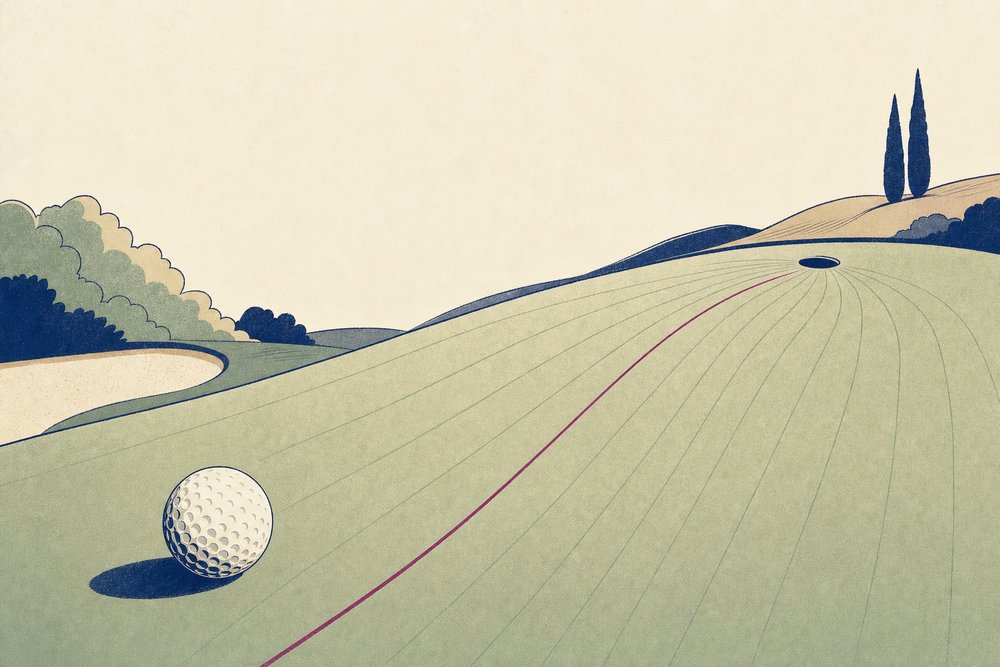
Many possible lines, one that finishes in the cup.
Because so few outright bets win, most golf betting in practice is each way. The structure is simple and the each way golf betting terms are where the money is. Your stake is doubled and split: the win half is priced as normal, and the place half pays a fraction of that price if your player finishes inside the paid positions.
Two numbers define it. The fraction, usually one fifth or one quarter, and the number of places, usually five to eight in a full-field event and fewer in a small field. A book paying one fifth across eight places and a book paying one quarter across five are offering genuinely different bets on the same player, and which is better depends on the price. Always read the each way golf betting terms before the price itself; the calculator above compares them for you.
A worked example
Take a player at 26.00 with ten dollars each way, at one fifth the odds for eight places. The total outlay is twenty dollars. The place part settles at 1 plus 25 divided by 5, which is 6.00, so a top-eight finish returns sixty dollars and the bet is well ahead even without a win. If he wins, both halves pay.
Now move to one quarter across five places. The place part becomes 7.25, so the return on a placed bet is higher, but there are three fewer positions in which to place. For a player likely to contend, the shorter, deeper-paying option is often better. For an outsider who might sneak a top eight, the wider one usually is.
The markets beyond the outright
Top five, top ten, top twenty
A finishing-position market without the each-way structure. You are paid if the player finishes inside the stated bracket, and dead heats are settled at reduced odds, which matters far more in golf than in most sports because ties for a position are routine.
First-round leader
Priced once the tee times are published, which means the draw is already visible. In an event where one half of the field plays in the morning calm and the other in an afternoon wind, that is real information rather than a hunch.
Two-ball and three-ball
The head-to-head between the players in one group, for one round only. It is the easiest golf market to reason about and the one most likely to teach you something, because the sample is small enough to review honestly afterwards.
Made cut
Will the player survive the thirty-six hole reduction of the field. The only golf market in which backing a consistent player with no chance of winning is a coherent position.
Golf odds explained in one paragraph
If golf odds explained had to fit on a scorecard, it would read: find the implied probability, know the terms, know the margin, then decide. That is how golf odds work in every market on this page, and it is why golf odds are so long without being generous. None of this makes golf beatable. It makes golf legible, which is different and more useful. Know what the price claims, know what the terms are, know what the margin is, and then decide whether you disagree with the book strongly enough to be interested. If you do not, the correct bet is no bet.
Divide one by the price. A decimal price of 26.00 gives 1 divided by 26, which is 0.038, or 3.8 per cent.
That number is the implied chance, and it already includes the sportsbook margin, so it is always a little higher than the book truly believes.
02
What does each way mean in golf?
It is two equal bets: one on the player to win, one on him to finish inside the paid places. A ten dollar each-way bet costs twenty dollars.
The place half settles at a fraction of the win odds, most often one fifth or one quarter, across a set number of places. Both numbers are set by the sportsbook for that tournament.
03
Why do golf odds add up to more than 100 per cent?
Because the surplus is the sportsbook margin. If the implied chances of every player in a market summed to exactly one hundred per cent, the book would have no built-in edge.
In golf that surplus is unusually large, because a field of more than one hundred and fifty players lets a small amount of margin hide inside each individual price.
04
Are longer odds better value?
No. A long price means the book thinks the outcome is unlikely, and it is usually right. Value is the gap between the real chance and the priced chance, not the size of the number.
Long prices do have one honest attraction in golf: the place terms attached to them, which is why each-way betting is more common here than in most sports.
05
What is the difference between fractional and decimal odds?
They express the same thing. Fractional odds show the profit relative to the stake, so 5/1 returns five dollars profit on one dollar. Decimal odds show the total return including the stake, so the same bet is 6.00.
Canadian sportsbooks usually default to American odds, where a plus number is the profit on a hundred-dollar stake. Every format can be converted to an implied chance, and that is the only form worth comparing.
06
Does the number of places change between sportsbooks?
Yes, and it is one of the few places where comparing is quick and worth doing. On the same tournament one book may pay eight places at one fifth and another five places at one quarter.
Which is better depends on the price of your selection, which is exactly what the calculator on this page is for.
golfbetting.ca sets no analytics or advertising cookies. If that ever changes, nothing non-essential runs until you accept. See our Privacy Policy and Terms of Use.