The game's rich past
The history of golf: who invented it, and why a round has 18 holes
Golf is first mentioned in writing because a government tried to stop it. Almost everything else about the modern game is an accident of one stretch of Scottish coastline.
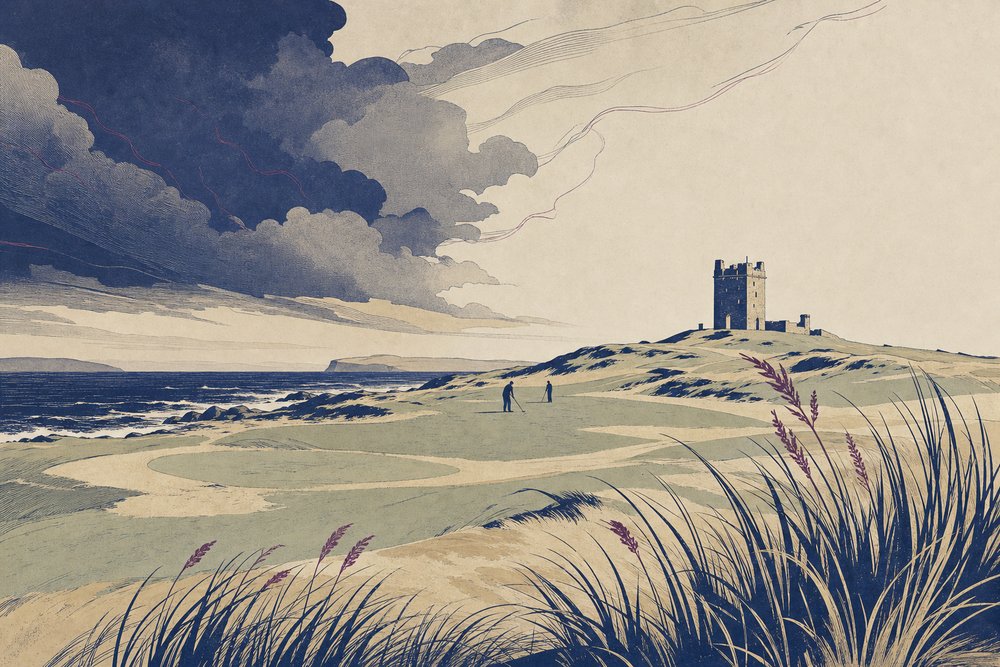
Nobody invented golf
People hit stones and balls towards targets with sticks for as long as there have been sticks. The Romans had paganica, the Dutch had colf, the French had jeu de mail, and each of them gets claimed from time to time as the true ancestor. None of them is, quite, because what separates golf from all of them is the hole in the ground.
That detail matters more than it sounds. A game aimed at a post or a door is a game of proximity. A game aimed at a hole is a game that ends, definitively, with the ball out of sight, and it is the thing that makes a score possible. Wherever the idea came from, it settled on the east coast of Scotland, on sandy ground between the farmland and the sea that was useless for anything else and happened to be perfect for this.
The ban of 1457
The first unambiguous written record of golf is an act of the Scottish parliament under James II, which ordered that football and golf be utterly cried down and not used. The reason was defence policy: men were playing games instead of practising archery, and archers won battles.
The ban was repeated in 1471 and again in 1491, which tells you exactly how well it worked. By 1502 the crown had given up entirely, and James IV is recorded buying clubs from a bowmaker in Perth. Within a century the game had a royal following and had crossed to the continent with Scottish traders.
Thirteen rules, one page, 1744
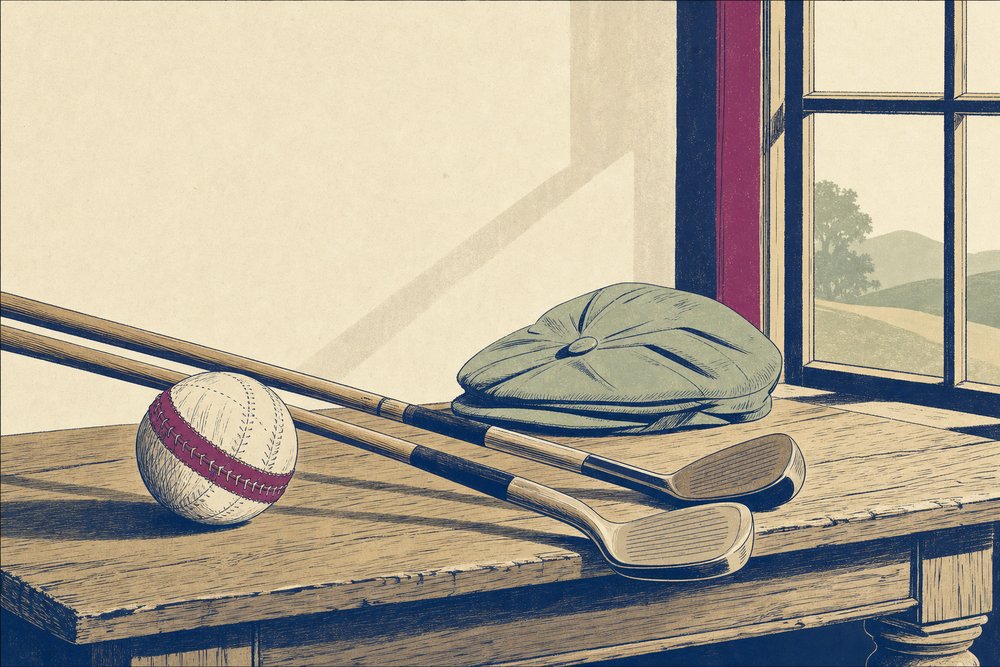
For three hundred years golf had no written rules. It did not need them: everyone playing had learned the same customs on the same ground. What forced the issue was competition. In 1744 the Gentlemen Golfers of Leith put up a silver club as a prize and had to state, in writing, what the competitors were agreeing to.
They wrote thirteen rules. Tee your ball within a club length of the previous hole. Your tee must be on the ground. You are not to change the ball you strike off the tee. Several are recognizable today, and several are extraordinary: if the ball comes among water, you may take it out, tee it behind the hazard, and play it with any club, allowing your adversary a stroke.
Ten years later the Society of St Andrews Golfers adopted almost the same set. That club became the Royal and Ancient, and over the following century its version became the version.
The accident of eighteen
Courses had whatever number of holes the ground allowed. St Andrews had twenty-two, played out and back along the same strip. In 1764 the club decided that the first four were too short and combined them into two, which left eighteen.
Nothing about eighteen is natural or optimal. It is simply the number the most prestigious club in the game happened to end up with, and as that club's rules spread, so did its arithmetic.
The ball changed everything twice
Until the 1840s a ball was a featherie: a stitched leather pouch packed with boiled feathers, painted, and made one at a time. A good maker produced a handful a day, and the price kept golf firmly in the hands of people who could afford to lose one in the whins.
The gutta-percha ball arrived in 1848. It was moulded from tree sap, cost a fraction as much, flew further and could be remade when it split. Golf stopped being a rich man's game almost overnight, and the number of courses in Britain multiplied within a generation. The wound-rubber ball at the turn of the century did the same thing again for distance, and course design has been chasing the ball ever since.
Canada, 1873
The Royal Montreal Golf Club was founded in 1873 and is the oldest in North America still operating continuously. Quebec City followed in 1874 and Toronto in 1876, and the game moved west with the railway.
That is not a metaphor. The Canadian Pacific Railway built grand hotels to fill its trains, and the hotels needed something for guests to do, which is why Stanley Thompson's mountain masterpieces at Banff and Jasper sit exactly where they sit. Canadian golf grew up as a railway amenity and ended up with some of the most spectacular ground in the sport.
Why the history still shows up in the odds
Wagering is older than the written rules. The 1744 competition at Leith existed because there was a prize, and the earliest accounts of the game are full of matches played for a stake between two players. The structure of a modern card follows from that: a head-to-head over one round is the oldest bet in the sport, and it is still the one the golf betting guide recommends learning first.
The eighteen-hole round, the cut after thirty-six holes and the enormous field are all inherited accidents, and each one shapes what a price can mean today. That is the thread the odds page picks up, and the reason the golf betting sites compared on our homepage are judged on their place terms and dead-heat rules rather than on their welcome offers.
Common questions
Questions about the history of golf
01Who invented golf?
No single person did. Stick-and-ball games existed across medieval Europe, and the version that became golf took its modern shape on the sandy east coast of Scotland during the fifteenth century.
The first firm written trace is an act of the Scottish parliament in 1457 that tried to ban it, on the grounds that it was distracting men from archery practice.
02When were the rules of golf first written down?
In 1744, by the Gentlemen Golfers of Leith in Edinburgh, for a competition. There were thirteen rules and they fit on a single page.
The Society of St Andrews Golfers adopted a near-identical set ten years later, and that club, later the Royal and Ancient, became the game's rule-making authority for most of the world.
03Why does a round of golf have 18 holes?
Because of one course. The Old Course at St Andrews was reduced to eighteen holes in 1764, when several short holes were combined, and the prestige of the club gradually made that number the standard everywhere.
There is no deeper logic to it. Earlier courses had anything from five to twenty-five holes, and the number simply followed the fashion of the leading club.
04When did golf arrive in Canada?
The Royal Montreal Golf Club was founded in 1873 and is the oldest golf club in North America still in continuous operation, followed closely by clubs in Quebec City and Toronto.
The game spread along the railway, which is also why so many of the great Canadian courses sit beside railway hotels in Banff and Jasper.
05What was the featherie ball?
A leather pouch stuffed with boiled feathers, hand-sewn and painted, used until the middle of the nineteenth century. A skilled maker produced only a few a day, which made balls expensive enough to shape who could play.
The gutta-percha ball of 1848 could be moulded cheaply and flew further, and golf became affordable to a much wider public almost immediately.